Ontology: the model of how your work actually gets done
Yours exists already, in your best people’s heads. Mereon writes it down and keeps it up to date, so your people and AI agents can all work together.
Turn what you already have…
- A screen recording
- A phone video
- A voice memo
- A PDF manual
- A Word doc
- A Confluence page
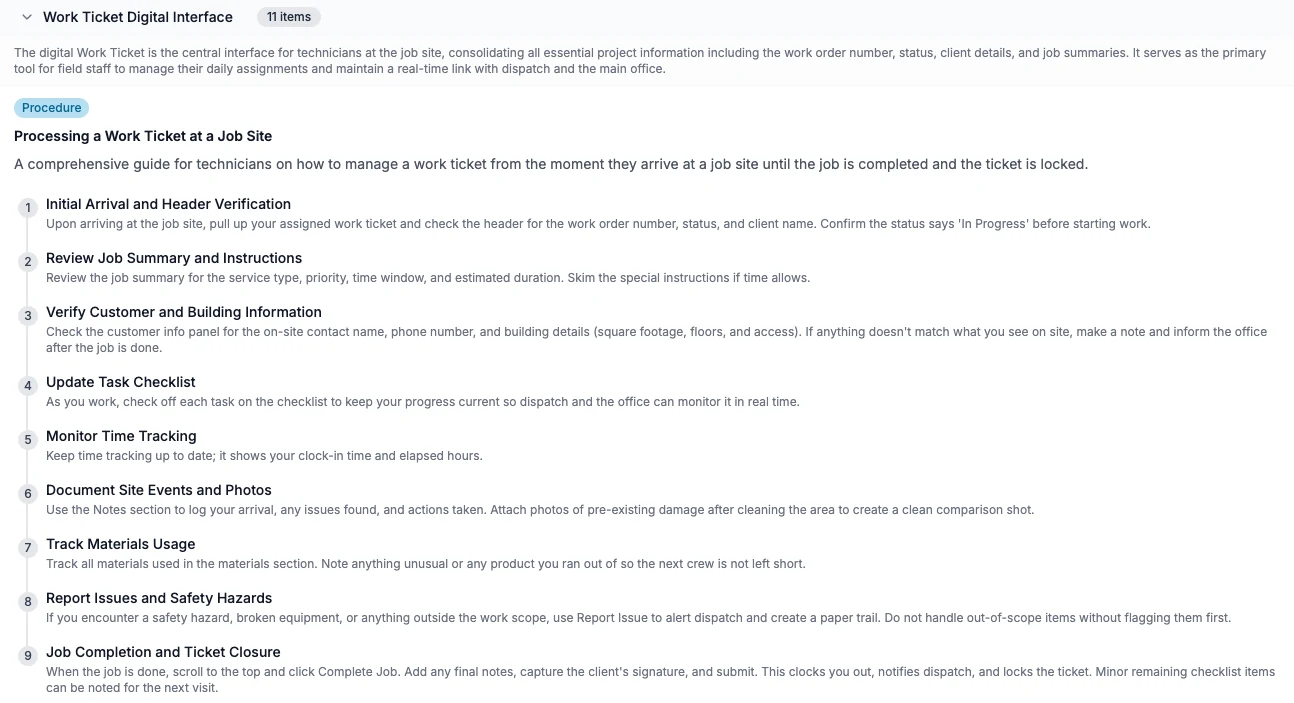
into a structured business ontology
What that gets you
Get someone new up to speed
They learn the job in an order that builds, and skip what they can already do. Two people hired the same month end up knowing the same things.
Keep what your best people know
When your most experienced tech takes a week off, the answers do not go with them. When they retire, the job stays behind.
Get straight answers, not plausible ones
Ask a question and get what your organization does today, with the clip or the page it came from, instead of a confident guess from a superseded document.
Know who can actually do the work
Not who watched the video. Who has shown they know a given thing, and when they last showed it.
Mereon’s AI finds what your documentation leaves out
Every gap below came from reading what one company had already written. The term nobody defined, the consequence nobody stated, the mistake nobody said how to undo. Your most experienced people fill these in from memory, and everyone else guesses.
Description
The current knowledge item lists the six service lines at a high level but does not explain what is specifically included or excluded within each one. A learner would need to know, for example: What tasks are covered under Office Cleaning (e.g., restrooms, break rooms, trash removal)? Does Floor Care include hardwood or only tile/carpet? What types of plumbing or electrical work fall under General Repairs? What surfaces or building heights are covered by Window Cleaning? What surfaces qualify for Pressure Washing beyond parking lots and exteriors? Without this detail, staff cannot accurately describe services to clients or set proper expectations.
Gap found in
Description
The policy lists "contract type" as one of the required verification fields, but there is no explanation of what contract types exist, where to find this information, or what constitutes a valid match. A new learner would not know how to verify this field without a definition and examples of contract types used in the system.
Gap found in
Description
The knowledge base states that the two-level selection ensures "accurate work classification," but does not explain what that classification actually drives. Learners need to understand how the chosen category and specific service affect downstream processes — for example, whether it determines assigned staff, pricing, required equipment, work order routing, or reporting. Without this context, learners cannot appreciate why making the correct selection matters.
Gap found in
Description
The knowledge base explains how the two-level dropdown works when making a selection, but does not address what happens if a user picks the wrong category or specific service. Learners need to know: Can they simply re-select the first dropdown and have the second reset automatically? Will changing the category clear any already-entered data? Is there a confirmation or warning step? This is critical for preventing and recovering from data-entry errors.
Gap found in
Change the procedure once, not in nine places
Add the new version and it supersedes the old one everywhere the old one reached. Lessons stop teaching it, answers stop citing it, and the next person who asks gets what you do now instead of what you used to do.
What it replaced is not deleted. It stays on the record for anyone who needs to know what the job used to be, and stops being something your people or your agents can be taught.
For your AI program
A better model will not fix bad context
Most disappointing rollouts are a context problem, not a model problem. The assistant is reasoning perfectly well over a pile of documents nobody has said anything true about.
Retrieval finds text, not context.
A search across your drive surfaces the 2019 procedure as readily as the current one. Nothing in a folder says which version you actually follow, so the answer comes back confident and wrong.
An ontology is the context layer.
Answer from a model where every topic has one current state and someone accountable for it, and the assistant is working from what your organization does today, with the clip or page it came from.
Your assistant and your training read the same context.
What someone is told in chat is what they were taught in their lessons, because both come from one model. Update the procedure once and both change together.
How it gets built
Nobody sits down and writes an ontology
Mereon drafts it from what your team has already recorded. Your experts correct it.
Point it at what you already have
The walkthrough someone filmed on their phone, the manual, the procedure doc. You write nothing new to start.
Mereon drafts the model
It reads the material and proposes the structure, showing the clip or the paragraph behind every claim.
Your experts correct it
They fix what is wrong and take ownership of their areas. Reviewing a draft is an afternoon. Writing one is a project.
Training runs off it from then on
Lessons, answers, and proof of competence all read from the same model, so changing something once changes it everywhere.
Ready to transform how your team learns?
Join teams already using Mereon to onboard faster, train consistently, and keep their best people focused on the work that matters.
Have questions? Chat with our team